Thursday, 19 May 2016

Practical Screencraft Part 2: Evaluation

For the second half of Practical Screencraft, I actually found it to be a challenge. My only experience with sound mixing and editing is in my spare time so this was a new experience from an academic level. I have almost exclusively worked on sound for video so having to focus solely on audio by itself was new to me. 

We were presented with a number of methods in order to produce sound for Soundcloud such as recording diegetic sound effects and incorporating them into a custom made music piece. While it was an interesting way of producing sound, it wasn’t something I felt confident with. Recording sounds was fine but trying to build music around it was tricky. I had to be inspired by the sounds but sometimes I just sat there with no inspiration. Getting over creative blocks was the biggest problem I faced throughout this module and greatly affected the outcome. 

For a number of the sound files on Soundcloud, I collaborated with other students in order to produce clips akin to audio dramas. We picked Dragon Age and Batman: The Killing Joke as inspiration for the pieces and let us voice act followed by editing. We also gained experience with setting up the sound equipment inside a professional studio space. Performing voice acting inside a proper studio was refreshing and much better than the times I’ve recorded at home for previous modules. 

The musical pieces took a while to get right as I have no experience with instruments keyboards so  I infinitely felt like I was producing music from riffing. I experimented with sounds and music tracks until I reached a sound I liked which I would then make into a full piece. My piece ‘Tom's Totally Not Boss Music’ was inspired by the style of music one might here fighting a boss in a video game. I found issues with composition as I started quite a few pieces however I would reach a point where it just wasn’t coming together and left the idea behind which resulted in only having a handful of sound clips left over.  In the future, I’d probably get myself more aquatinted with the program and the means of composing inside with the large number of composing options.  


Overall, I believe the module could have gone better. My inexperience with sound making software held me back in the process of making sound clips which is something that I can work on in the future. I know what works and what doesn’t so I can learn from the experience. In hindsight, there was much more I could have done and will most likely expand on some of these ideas in the future.

Monday, 21 March 2016

Moving Narratives 2: Evaluation

After being given the assignment and watching a few films, I actually had a hard time coming up with a feasible idea that I was content with. The only film that I found inspiration in initially was ‘Wrong’ as I enjoy making crime based films. It wasn’t until we watched ‘Down by Law’ that I finally found a film that sparked an idea for a short film that I could truly make well and feel happy with.

After my last film for Comparative Film Practices was a much more serious film, I wanted to get back to making more comedic based films that had a much more simple style to it. I wasn’t happy with how my Comparative Film Practices film turned out and I think the tone is largely to blame for this. The idea brewed from the concept of prisoners sharing a cell and all but one of them want to break out. The one left over preferred staying in prison due to having a terrible life outside. With this in mind, it snowballed into the final product very well as I managed retain the image from the inception of the idea to what was made.

In ‘Down by Law’, around a third of the film takes place inside a prison cell with only the main three protagonists being seen on screen. I loved the idea of this as it really made the audience feel enclosed in the cell too with only the prisoners to relate to. Jim Jarmusch’s style also appealed as he would set up the camera for long shots that lingered at a particular angle. To capture this style and keep the claustrophobic feel, I decided to have the camera stay in the exact same position throughout the film and shoot it as a long take.

What I found most interesting about this submission was how the idea almost completely changed when filming took place. Initially, there wasn’t much to look at since it wasn’t too deep. It was initially just two prisoners in jail. That was it. However, when I came up with the idea of playing all three characters with only one ever being physically seen, I realised it could work as a metaphor for a trapped mind. A person imagining themselves as their own companion locked up. The reason they would also act as the guard could be seen as self-doubt. It was quite a discovery when I realised this and I felt proud that there were a number of ways one could interpret my film.

Comparing this film to my previous submissions, I found this one the most experimental and actually quite risky. Because I played all three characters, I had to make sure I timed the dialogue perfectly or else there was a chance I could be left with long pauses of silence or the dialogue was too quick, giving no time to insert the voices of the characters off screen. It therefore made editing quite a challenge in order to make sure everything lined up correctly. This film relied heavily on the editing to make sure it made sense.

Despite being a seemingly simple idea, it actually took me a while to get the script off the ground. Because of the free form style of just following a person’s time in jail, it was hard to pin down a narrative which is when I tied in the idea about criminals wanting to break out with one wanting to stay behind. Ultimately, while I did have a script to follow, there were times during the shoot where I went off script and using improvisation to create new dialogue which I realised wasn’t a good idea for a film where I had to work off myself. In the long run, it worked out by recording the different character’s dialogue separately rather than try to tackle it in sequence.  

Something I wanted to explore too is being able to create distinct characters in a very short space of time. Only one is named (Terwilliger, who is named after Sideshow Bob’s real name from ‘The Simpsons’) as he is the only character seen on screen. The rest, despite not being named, are given varied personalities with the second prisoner being more cowardly and emotional than Tewilliger and the stern, loud and abrasive guard who watches over them. It would make for a much more interesting dynamic between the two characters if they had completely opposite personalities.

In fact, making sense was one of my biggest concerns. Unlike previous films which I was able to get the point across easily to the audience, I feared that this would leave the audience a bit confused. The moment that I felt this was most apparent was when the second prisoner is introduced. The first prisoner’s head is out of shot so I thought that it could interpreted that he was making the second prisoner’s noises. This is also the reason that I decided to perform a variety of voices for the characters to make them stand out more as well as get over the challenge of providing a voice only performance.

Something I realise in hindsight that is an issue with my film is the lighting. In the solo scenes, it is very effective as it highlights the single character and having his shadow on the wall is aesthetically pleasing. However, it doesn’t make sense when the other prisoner is introduced. His shadow is not seen on the wall which would mean that the light source is coming from the inside of the cell between the two characters. Originally, I set out with the idea of having the shadows of the prison bars going over the prisoners however I couldn’t get this done in time for the shoot. On the flipside, the isolated feel with the focus on a solo character made it feel more like a play which is an area in which I received my acting training. It felt good to convey my previous expertise.

One problem I had with the editing side of the project was that I actually had too much to fit into the running date allocated to us. Being long takes, I had almost half an hours’ worth of footage however that meant there was a lot that I had to cut out. The big problem here is that the final cut loses a fair bit of character development such as why the first prisoner is so desperate not to leave prison or even a trait that saw him singing prison songs every now and then. I’m almost tempted to create an extended cut just to have and to make me content with the project as a whole.

This is a film that I am not only very happy with but I’d actually be willing to remake someday. Not just reinterpret but outright remake scene for scene. The only things really letting me down are the camera and sound quality so if I had a full crew and actual actors to work off; it could easily be of a higher quality. While I will defend my choice to play all three characters, I do think it would’ve been easier to have someone else assist with filming. Although on the film side of this is that having no-one else around let me do much more improvisation which helped flesh out the characters much more.


In summary, I am proud with how my film turned out. It’s one of the only times where I felt I’ve nailed exactly how I initially envisioned my film to be. The camera was set up exactly how I had hoped, I managed to convey a sense of multiple characters despite playing them all myself and having the problem with not interacting with anyone when filming. It was a challenging film to make however I still had fun filming it. It was refreshing to take a break from more comedy based films with the last module however I think I’m better at that then the more serious kind of film. Hopefully down the line I can find a good compromise between the two but, so far, this submission is the closest I’ve gotten. It’s a dark, serious setting with unconventional conversations and awkward based comedic timing. I felt I was able to use both my skills as a filmmaker (due to the emphasis on editing and lighting) and an actor (playing multiple roles, most of which through voice) which, while not my initial aim, is something that I came to learn as the project went on. 

Thursday, 17 March 2016

Moving Narratives 2: 'Joint' Script

PRISON
The cell door is heard opening as guards squabble to throw a guy in. He falls into shot, hitting the wall.

GUARD
Get settled. You're gonna be here a while.

Prisoner looks around the cell.

PRISONER
(Unfazed)
OK!

GUARD
....alright.

Guard leaves the cell as Prisoner leans against the wall.

TIME JUMP
Prisoner is pacing back and forth.

PRISONER
Well then...

TIME JUMP
Prisoner leaning against the wall listening to a prison riot, shifting when stuff is thrown around. A grin appears on his face.

PRISONER 1
You scream, I scream, we all scream for Ice cream!....No? No one? Ah, you're no fun...

TIME JUMP
The cell door is heard opening as Prisoner instantly stands up. The guards throw in another prisoner.

GUARDS
Get in there!

PRISONER 2
NO! NO, YOU CAN'T!

He hits the wall as Prisoner 1 watches the commotion.

GUARD
Enjoy your new roomate

PRISONER 1
You're not the boss of me

GUARD
Yeah we are

PRISONER 1
Uh, yeah, kinda.

Prisoner 2 is heard in pain

PRISONER 2
Uhhh...soo..what are you in for.

PRISONER 1
Broke into a mall, you?

PRISONER 2
I cut out a mans liver and fed it to him.

Prisoner 1 stares blankly

PRISONER 1
....ok

TIME JUMP
Prisoner 1 is messing with the bricks on the wall.

PRISONER 2
Hey, wait a minute

PRISONER 1
What?

PRISONER 2
How'd you get away with that hair in here. They cut mine

PRISONER 1
Yeah same.

PRISONER 2
You said you've only been here for 3 weeks.

PRISONER 1
Yeah.

Beat

TIME SKIP
Another riot is commencing.

PRISONER 1
What's with you?

PRISONER 2
It's scary man...all that shouting

PRISONER 1
Nah, it's, well, a riot.

Something smashes

PRISONER 1
I'm sure that wasn't expensive.

PRISONER 2
But

PRISONER 1
Oh come on, it's cool to see the other guys take over this place. See, there's Fun Bobby chasing those guards...op, down he goes.....hey have you ever seen Down By Law

LONG TIME JUMP
Prisoner 1 watches Prisoner 2 panic.

PRISONER 1
Wow, wow man what's up?

PRISONER 2
I can't take it anymore. I want out.

PRISONER 1
Well, you kill someone, you're probably gonan wind up here.

PRISONER 2
I...I just gotta plan an escape

PRISONER 1
Ohhh how cliche. Well, don't let them here that

PRISONER 2
You want in?

Beat

PRISONER 1
No!

PRISONER 2
What? Why?

PRISONER 1
Roof over my head, food, excersise yard, showers. Hell, I got it better in here than out there.

PRISONER 2
Ohh...

TIME JUMP
GUARD
Alright maggots, out into the yard.

Prisoner 1 stands up

PRISONER 2
It's time.

PRISONER 1
Huh?

PRISONER 2
My plan...

PRISONER 1
Yeah, good luck with that...

TIME JUMP
Prisoner 1 is drumming against the wall until an alarm is heard. He listens to the sound of guard dogs and guard whistles joining. He gets a smirk across his face.

TIME JUMP
Commotion is heard as the guards drag Prisoner 2 back into his cell.

PRISONER 1
Welcome back. But, if I may, why not somewhere more isolated

GUARD
Prison's full

PRISONER 1
Ah.

PRISONER 2
Uhhhh

Guard hits him

PRISONER 2
Quiet maggot

LONG TIME JUMP
Guard bangs on cell.

GUARD
Terwillger!

PRISONER 1
What?

GUARD
You got bailed

PRISONER 1
What?!

PRISONER 2
Lucky

PRISONER 1
But...but I like it here

He steps towards the guards who grab him

PRISONERS 1
Where are you taking me. No! NOO! I DON'T WANT TO GO! STOP! NOOOOO!

Beat

PRISONERS 2

Baby

Tuesday, 15 March 2016

Moving Narratives 2: Inspiration

Initially, none of the films really sparked my interest in terms of using ideas from them for my own film. At most was 'Wrong' which featured a bizzare sense of humour and some ties to crime with the use of an incompetent detective character. However, after being shown 'Down By Law', an idea grew from seeing three strangers bonding in prison.


The only idea I had to start with was two criminals sharing a cell with one wanting desperately to break out while the other would actually prefer to stay in jail. I used that as the base and build around it with a combination of improvisation and thinking about the interactions in 'Down By Law'. The three characters were surprisingly likable despite their negative demeanours for the most part and we earnestly want to see them make it to the end of their journey unscathed.


The interaction specifically with Roberto (Roberto Benigni) and the other two, Zack and Jack (Tom Waits and John Lurie), was the main driving force behind my film. We learn that, out of the three, Roberto had committed the worst crime as he murdered someone while the other two were set up for lesser crimes. It's interesting that the funny, light hearted member of the trio is the one who did the worst crime while the negative, down to earth characters are the seemingly innocent ones. I constructed the two prisoners in my film with this in mind as one simply broke into mall while the other, seemingly more comedic one, killed someone horrifically. It makes more a good comedic set up ripe for character interaction.

Monday, 14 March 2016

Moving Narratives 2: Idea

Before settling on the final film, I managed to come up with an idea based on 'Wrong'. This film I came up with would actually serve as a sequel to my last Moving Narrative film. 'Misplaced' focused on a noir detective being thrust into the real world, forcing himself to see crime wherever he went so I wanted to expand on this by having the same character get involved in a real crime. However, I personally found there wasn't much I could do to expand on this idea.

I initially started this film in the planning stage with the potential of following up the previous crime of finding out who killed a fish but, due to the lack of scope, I felt apprehensive. It was until we were shown 'Down by Law' that I found a film with a gritty setting yet a relaxed tone and characters. I was able to keep it set in the crime genre but, rather than my previous films which showed a crime being performed, I was able to show the aftermath with a prison setting.

The first step was creating the characters. The only named character involved in the narrative is Terwilliger who I named after the character Sideshow Bob (whose real name is Robert Underdunk Terwilliger) as it tied in with the prison setting that Bob is usual seen in as well as a justification for my hair. I had decided to play Terwilliger because I felt I could convey what I had intended easier. The second prisoner is very loosely based on Roberto from 'Down by Law'. The only traits I took from him were him being the comedic foil to the other more serious prisoners and the fact that, out of everyone in that cell, he had committed the worst crime. The prisoner's squeaky voice was picked as I wanted something to be in stark contrast to the more deadpan, low voice of Terwilliger. The voice itself being an impression of Morty from 'Rick and Morty' for no other reason than it just fitting in well.

After deciding to star in the film, I thought that it would be best to play all three characters. As a result of this decision I realised I had just given the film a much deeper meaning. Initially, I felt there wasn't too much to look and set out just to make a quirky prison film. Instead, I ended up with a film about a trapped mind with a person seeing themselves as everyone. As their companion, as their superior, it made much more sense.

The name of the film, 'Joint', came from a number of definitions of the word. Joint is a slang term from prison, reflecting that the film is set entirely within the prison, and it also conveys the imagery of the corner of the room, where the walls join up.

Thursday, 28 January 2016

Comparative Film Practices: Evaluation

Looking at how my film ultimately turned out, I found it intriguing how much the tone had shifted from the conception of the idea. The main driving force behind my project was the inspiration and how much I wanted to capture that. The biggest draw for me were the portrayal of villains from the TV shows ‘Jessica Jones’ and ‘Sherlock’, specifically looking at the characters of Kilgrave and Charles Augustus Magnussen respectively. Kilgrave especially helped shape the film as his struggle to win over Jessica in his own sadistic and desperate way was the basis on which the film was built upon.  I wrote a film last year about unrequited love however that was played straight so this time I explored an exaggeration of it.

When coming up with the names for the characters, I had to take certain things into consideration. As a tribute to ‘Jessica Jones’, I wanted to feature a moment reminiscent of it and, as a result, needed a name that had three syllables like Jessica. What drove me to pick Eleanor was the song ‘Elenore’ by The Turtles as I personally feel it has a similar theme as my film and it would make for a good moment when the antagonist sings it. Speaking of the antagonist, his full name (while not all in the film) was derived from the two men who created the protocol that would allow the World Wide Web to run, Robert Kahn and Vinton Cerf, which I blended into Robert Vinton although he is only referred to by his surname as it just seemed more fitting.

The biggest challenge I faced was trying to convey the subtle meaning behind the film. In order to apply the use of analogue and digital, I came up with the idea that the antagonist was a human embodiment of the internet which would explain why he’s clingy, voyeuristic and defeated by a lack of internet connection. I still believe the idea and intention is still in the final film however I fear it is much too subtle to the point where audiences wouldn’t be able to identify it. I suspect people will focus too much on the relationship aspect of it rather than question why he has access to phones and intercoms.

To enforce the idea of internet and relationships, I focused on two characters that can represent Donald A. Norman’s idea of the ‘Machine Centred View’ which declares that machines show characteristics such as being precise, rigid, and insensitive to change while humans are the opposite. I saw this as good grounding to build characters from by having them be polar opposites. I also wanted to capture this through the cinematography. For the first two thirds where Vinton has control, I wanted him to be positioned in the centre of the shot unless I was more dramatic effect while Eleanor would be off centre. This would switch towards the end with the crossing point being their encounter on the stairs when the both are centred. The last shot of the film emphasises this by making sure Vinton is to the right.

Initially, I found the idea of filming this a bit daunting as this was a much more ambitious project however I found it manageable by splitting the film into thirds and filming each third individually. There were a few moments within each third that had to be filmed out of sequence but, ultimately, I think it came out as my best looking film so far. I’m proud of quite a few shots and the colour and lighting worked in my favour. The best example is how the lighting showed off Kilgrave’s influence as he is commonly known as The Purple Man and the light on Vinton in the penultimate shot makes him look like a light shade of purple.

It was hard to convey the narrative to the cast and crew as I feel the film can only make sense when all edited together. Editing wise, the influence of ‘Sherlock’ is apparent most notably through the use of on screen text to show what is displayed on a phone. I find this technique much more engaging than cutting to the phone screen as it can be disorientating and makes it harder to read the message. I also made sure that I used the same font that is featured in ‘Sherlock’ which has been used for London transportation since the 30s. It’s not too distracting; it makes the film more unique and gets the message across easily for the audience.

The original idea was much darker and focused much more on paranoia with Vinton displaying his knowledge of the people he knows much like how websites remember information you input which also would have tied in the influence from Charles Augustus Magnussen. Magnussen retains a large amount of information on people in his mind so he can use this for blackmail. The only influence of Magnussen that has retained is Vinton watching Eleanor through his computer. There were close ups of Vinton, mostly focused on his glasses, which has inspired by similar cinematography from ‘Sherlock’.

After filming and looking back on the footage, I found that, while the creepy tone is still there, there was a bit more of a black comedy vibe to certain scenes. For example, Vinton sings ‘Elenore’ in a much more casual tone than originally intended and I think it added to his character a bit more. He also conveys much more exasperation at the end. It’s fascinating to see things change between how I originally envisioned it when writing and coming up with the idea compared to how the final product actually turned out.


If I were to point out where any of my improvements have emerged from, it would be framing and lighting. Previous projects, both in and out of college, have suffered from bad lighting as they are either blown out by natural lighting or covered in shadows. This time, I used proper lighting equipment and the film looks better for it. More detail can be seen with faces being lit up more effectively and the only prominent shadows are giant ones cast on the wall, creating a nice effect. With a stronger idea of how I wanted this film to be framed, there are a number of shots that came out really well. I consider this a big improvement over previous films I have made. I feel this is because I experimented more with equipment and ran with an idea I had since the start, allowing me to develop it further. 

One aspect I had to tackle was finding fitting locations that I could realistically film in. I had rough ideas of the sort of atmosphere I wanted but when actually trying to think of places to film, I was too worried about people interrupting shots which is a problem with filming in public locations. The third act was the hardest but luckily we found a large stairwell that had enough light and echo to accurately portray what I was aiming for.

With the echo already taken care of, I still had to do a fair amount of sound editing in post. Two moments when Vinton uses technology to talk to Eleanor required sound editing after filming. The first example of the screen turning on with him on it was a simple matter of playing the audio from the original video that is being played with a radio filter but the second took more effort. I had to splice between Vinton speaking into the microphone and Eleanor reacting (filmed separately so Eleanor’s actress was reacting to nothing) and then add both the radio filter and reverb in order to make it sound grander and match the natural echo that the stairwell has.

To summarise, I felt this project went better than anticipated. From a behind the scenes look, I used for equipment (mostly lighting) to make the film look much better than previous ones with more detail highlighted and a better sense of framing is apparent. I was a bit cautious of the content and tone of the film as it is a departure from what I’ve previously done. In terms of how I think the final product turned out, I still feel that the internet based undertones are too subtle to the point that most people wouldn’t pick up on them however I’d rather it be open to interpretation like that instead of being so blatantly spelt out for the audience with nothing for them to take away. 

Wednesday, 27 January 2016

Comparative Film Practices: Characters for Film

The grounding on which I built the characters on is derived from Donald A. Norman's The Invisible Computer*, specifically the seven chapter on 'Being Analogue'. The main draw from this is the Machine-Centered and Human-Centered Views.

Seeing the contrast between people and machines inspired me to create two characters, one who represents humanity and one who represents machines. Applying the idea that Vinton represents the internet, this was easier to pull off. The two main elements that stuck out between Vinton and Eleanor are their contrast between Vague and Precise (Eleanor having no lines compared to Vinton's numerous) and Attentive to Change and Insensitive to Change (Eleanor learns to let go off Vinton's bonds while he's left scrambling for her phone)

For Robert Vinton. I came up with his name by compiling together the names of the two men who are responsible for the Internet, Robert Kahn and Vinton Cerf. While they didn't outright create the internet, they are the two most often associated as doing so as they created the TCP which is the protocol that allows programs such as the World Wide Web to work, ergo giving the world access to the internet.

As to be expected with most of my films, I was hoping to play the role myself however, unlike most cases where it was required, I am writing this role specifically for me as I've always wanted to perform a character like Vinton. My long, unkempt hair would also work well in contrast to the suit and glasses, much like how Kilgrave from Jessica Jones appears to be well kept except for the unshaven stubble.

*Norman, Donald A. The Invisible Computer. Cambridge, Mass.: MIT Press, 1998. Print.

Comparative Film Practices: Script

INT. BEDROOM
ELEANOR is lying on her bed, texting on her phone. Camera cuts to show establishing shots of computer monitor, DVD shelf etc. A muffled voice is heard and she looks around confused. Her computer monitor switches on with a fuzzy picture. She stares at the screen as VINTON's face finally comes into view.

vinton
There you are. On your phone

Holds his up 

VINTON
Got mine still...got my phone...you can always contact...

She is visibly disturbed by the sight of VINTON.

VINTON
Look, all that aside, I really think we got off on the wrong foot. 

Eleanor stares in silence

VINTON
Oh! Yeah, you thought I was...gone...yeeeah no. Not that easy, I'm afraid. We should just...I don't know, meet up and just talk things through. 

ELEANOR leaves.

INT. SCREEN ROOM
Focus on VINTON's eyes through his glasses as he watches in delight. Cut to a shot of behind him as we see a desk with multiple monitors watching live security cameras.

EXT. STREET 
ELEANOR walks down street at a reasonably fast rate. She is clearly disturbed. She receives a message on her phone from VINTON: "You've forgotten, haven't you :/". 

INT. SCREEN ROOM
VINTON watches ELEANOR go into the building, switching camera to the interior. He smirks and leans into a microphone.

INT. CORRIDOR 1
ELEANOR walks down a hallway, still worried. She takes a moment however this is interrupted by VINTON's voice over the intercom, cutting between her listening and him speaking.

VINTON
It's exhilarating, isn't it. Well, it would be anyway. If it was anyone else but it's you. We know how this goes. You'll act all...defensive but I know you too well. You'll come back. You always do. 

After he stops she moves on.

INT. SCREEN ROOM
VINTON starts to appear confused and distressed. He takes his glasses off and gets up. As he prepares to leave, he quietly sings 'Elenore' by The Turtles.

INT. CORRIDOR 2
ELEANOR runs up stairs and enters another empty corridor. She sighs having not heard from VINTON however the lights go out, plunging her into darkness. As the lights flicker back on, VINTON is standing down the hallway. She stares at him.

VINTON
Do you see what comes from all of this running around? It must be exhausting.

He takes a big sigh and takes his phone out.

VINTON
Now...

He checks his phone however he has no signal. He glances between ELEANOR and his phone.

VINTON
Hang on...bear with...

He checks his phone again. No signal. ELEANOR checks her phone and sees full signal. ELEANOR looks VINTON down and her expression shifts from concern to content. VINTON's expression shifts from confident to concerned. 

VINTON
What?

ELEANOR waves her phone in a taunting fashion, places it on the floor and pushes it slightly towards VINTON.

VINTON
What are you doing?

She walks towards stairs.

VINTON
Come back here, Eleanor...

She leaves. He panics

VINTON
(Yelling)
Now, Eleanor!

His voice echoes. He's alone. He stares at ELEANOR's phone. He runs to it and desperately picks it up. No signal. 


Tuesday, 26 January 2016

Comparative Film Practices: 'Elenore' by The Turtles Lyrics

After deciding on the name Eleanor for my protagonist, I wanted to incorporate the song 'Elenore' by The Turtles (which I first heard from 'The Boat That Rocked') and I realised that, after reading the lyrics, they hold a stronger link to my film. My take on the song is that it is about unrequited love. I found the lyrics particularly fitting and after hearing that it was a parody of their other hit 'Happy Together' the year before, it takes a new angle as it doesn't take itself completely seriously. In addition the joyful tone of the song would work well in contrast to my more bleak film.

You've got a thing about you
I just can't live without you
I really want you, Elenore, near me

Your looks intoxicate me
Even though your folks hate me
There's no one like you, Elenore, really

Elenore, gee, I think you're swell
And you really do me well
You're my pride and joy, et cetera

Elenore, can I take the time
To ask you to speak your mind?
Tell me that you love me better

I really think you're groovy
Let's go out to a movie
What do you say now, Elenore, can we?

They'll turn the lights way down low
Maybe we won't watch the show
I think I love you, Elenore, love me

Elenore, gee, I think you're swell
And you really do me well
You're my pride and joy, et cetera

Elenore, can I take the time
To ask you to speak your mind?
Tell me that you love me better

Elenore, gee, I think you're swell, ah-ha
Elenore, gee, I think you're swell, ah-ha-ha


Kaylan, Howard. Elenore. White Whale, 1968. CD.

Wednesday, 13 January 2016

Comparative Film Practices: Inspiration

Jessica Jones:

For inspiration for characters, I was intrigued by the main antagonist Kilgrave (David Tennant). Kilgrave presents himself as a sophisticate purely based on his fashion and taste yet still physically retrains a darker, crazy side through his unshaven stubble. He wears suits, dines in fancy restaurants, relaxes in high rise apartments yet his screen presence is unnerving.


When coming up with my idea, my mind went to Kilgrave as I wanted to create a film about obsession, specifically over a particular person, which is what Kilgrave does. He obsesses over Jessica and stalks her both physically and mentally. He possess the power to command people without question which left Jessica with PTSD, allowing Kilgrave to haunt her mind as well as in person. I wanted this to come across but rather than the mind, have it be through technology. Appearing on screens, phones, intercoms, everything. 


The idea was to have my character be the personification of the internet as we throw our trust at this abstract entity including our personal information, bank account details and interests. Having this blowback through being stalked someone who's passion is unrelenting despite all the terrible things they have done would be an interesting concept to explore. 


Sherlock:

Aesthetically, I was drawn into Lars Mikkelsen's performance as Charles Augustus Magnussen from Series 3 of 'Sherlock'. Much like Kilgrave, he also wears suits and lives a high class lifestyle however, unlike Kilgrave, nothing seems physically off about him. He wears glasses, sports a beard and that's about it. All that remains is his mind which is where his threat lies.


Magnussen is a blackmailer and as a result has to keep a large amount of information on people in his 'vault' and POV shots show him basically scanning people like a robot. The revelation at the end of the series reveals that the vault is an abstract place located in his mind, very much like Sherlock Holmes', which struck a cord with me when character building.


Having the villain in my film be the internet fits perfectly with Magnussen who is almost a living computer, able to access any dirt on a person within seconds. Before the revelation, Magnussen's 'vault' is physically seen (the audience not knowing it's abstract at his point) and this was the initial vision that sparked my idea. We first see glimpses of him watching Sherlock on a number of computer screens in a dark room, the camera lingering on his cold eyes as he watches in amusement.  


Ant-Man:

There wasn't a whole lot I am taking form Ant-Man as it almost has nothing to do with my film however it was worth bringing up that there is one shot that stuck out.


This shot of Hank Pym (Michael Douglas) watching over many monitors sums up exactly what I'm aiming for in terms of tone, look and aesthetics. A lone suit-wearing man watching over someone on screens. 


Wednesday, 9 December 2015

Practical Screencraft: Evaluation

Overall, I feel pleased with how the assignment turned out. When I look back on previous works compared to this one, I believe that the film made for this assessment is one of the better pieces of works I’ve been involved in and collaborating was a very good idea. I doubt I could have pulled off a film that I’m as content with if I was on my own. I took on the role as actor for it with my collaboration partner as cinematographer and camera operator. We were both intrigued by how the ending of ‘The Graduate’ was shot and I feel that we managed to capture the look of it very well. I am very proud with how the last shot came out in particular. It not only is framed the same as the source material but the camera movement matches it too, therefore capturing the feeling of the shot complete with the same music. I also feel accomplished by the use of sound. We edited it in a way to make the audience think the music is non-diegetic, like ‘The Graduate’, until the headphones come off and reveals that it is diegetic. A nice twist on the original film. Having our film book ended by Simon and Garfunkel music helps remind the audience what it is based on and adds to piece.

On the flip side though is that I’m not too sure how the video analysis worked out. In my opinion, I believe that I spent more time bringing up examples yet never actually using them or pointing out why I brought them up. However, I do like that I managed to analysis the ending of ‘The Graduate’ from the perspective of an actor as well as talking about other elements of film I enjoy such as use of sound and cinematography. One thing I had to do was shorten the analysis for several reasons. One was because I felt I spent way too long talking about ‘Skyfall’. There was a lot to talk about regarding what ‘Skyfall’ did similar to ‘The Graduate’ however it detracted from the original task at hand and that being analysing the ending of ‘The Graduate’. Compared to my previous attempt at a video analysis, I believe that I this is an improvement. My voice over sounds more professional as it is scripted as opposed to my previous improvisational style more reminiscent of a director’s commentary. This was made more in the style of an analysis and I feel that I managed to convey that. 

Combined, I think that both halves of the film fulfill the assignment brief. I analysed ‘The Graduate’ by looking at what stuck out to me and how the film makers used these techniques and then applied them into my own film. The biggest struggle was the idea for a film which, I previously mentioned, I had to collaborate on. Being in the same boat as someone else allows for strong collaboration that can bring about new ideas to consider filming. We had ideas that can be used depending on the weather as we ended up not using our original idea due to bad weather. I had seen ‘The Graduate’ prior to this assignment however looking deeper at how it was put together gave me a stronger appreciation for the film and comparing it to ‘Skyfall’, a film that I know inside and out, gave me the ability to ground it and analysis it easier. In summary, I came out of this project fulfilled and pleased with how it went. We captured the feeling and the look of the film very well and will look back on this film as one of the better films I’ve had a hand in making. 

Practical Screencraft: Chapter 1 Script

TOM
When looking at the ending of The Graduate. The main aspect that stuck out to me was the use of cinematography combined with acting. The most prominent shot that shows this off is this one
Running shot

TOM
In a way, the camera is conveying the feeling of the scene by making Ben (Dustin Hoffman) appear as if he is running on the spot, going nowhere. It adds to the urgency of the scene as he runs to make it to the wedding. Speaking of the wedding, the way the shot pans towards the church makes the shot work out of context. Out of context, you see a man struggling to run quickly towards a church. That's all you need to understand the situation. In terms of acting, Dustin Hoffman has to also convey the very same feeling as the camera through the use of his body due to the lack of dialogue. Compared to the previous shot, he is running much more vigorously with his focus locked either straight ahead or towards the church.

TOM
This shot actually reminds of another film, Skyfall. (Oh look I'm talking about Bond, how shocking). Skyfall sees the main villain, Silva, debut using this technique as he tells a story for character establishment. What's intriguing here is that, the shot before shows the layout of the room from a different angle which establishes how big this room is. We then see the aforementioned shot and it feels like the room has become bigger. It's very effective as a result. See, it's not just an excuse to talk about Skyfall...

TOM
In addition to the acting and cinematography, the use of sound also caught my attention. The scene begins with 'Mrs Robinson' by Simon and Garfunkel blasting triumphantly as Ben speeds towards the church. However, The song begins to slow down and come to a stop parallel to Ben's car stopping. The lack of music on wards you would think would make the scene feel less dire but it the emptiness and realism of the diegetic sound just makes it feel more ambiguous as to whether he will make it or not. And what happens when he does? The sound of a guitar is heard. How about when Elaine is watching her family scolding Ben. She can't here them because her sub-conscious is focused on what matters more, that being Ben crying out her name. As the film comes to an end, the tone changes drastically. One would think that it would be a happy ending as Ben reunites with Elaine and can be together. Except it doesn't. Instead, the camera lingers on their faces as they slowly begin to realise what they've done and how their lives are going to pan out. All to the Sound of Silence. (Also I liked the that this scene here fits the line in the song "People talking without speaking". 

Tuesday, 8 December 2015

Practical Screencraft: Test Shots

After studying the ending scene from 'The Graduate', we set out to try and recreate two distinct shots. The first involves a subject walking/running towards the camera in an effort to make it appear as if they are taking longer than necessary or running on the spot. This effect can be used in a number of ways, notably to convey a sense of struggle or create a feeling of unease. We plan on using this for the former example within the context someone being late for a bus. Here though, we just practiced down a hallway in order to capture a long stretch of area we could run down and record. 


The main way going about this is positioning the camera in a certain way while zoomed in and, as the subject is approaching, zoom out the camera. This gives the effect that the subject is further away then they actually appear. This creates the effect that the destination they are trying to reach is a struggle and feels just out of reach. 

The second shot was a the very last shot from 'The Graduate' which sees the bus Ben and Elaine are riding on drive away from the camera. It's a handheld shot that follows the bus a little bit before stopping.


I feel we captured this very well. It was quite simple as all it required us to do was follow the subject for a bit and then stop while the subject continues on. 

We had to make sure that we could accomplish both shots in order to put them into our final film and convey our inspiration from 'The Graduate'. 

Monday, 7 December 2015

Practical Screencraft: Chapter 2 Idea

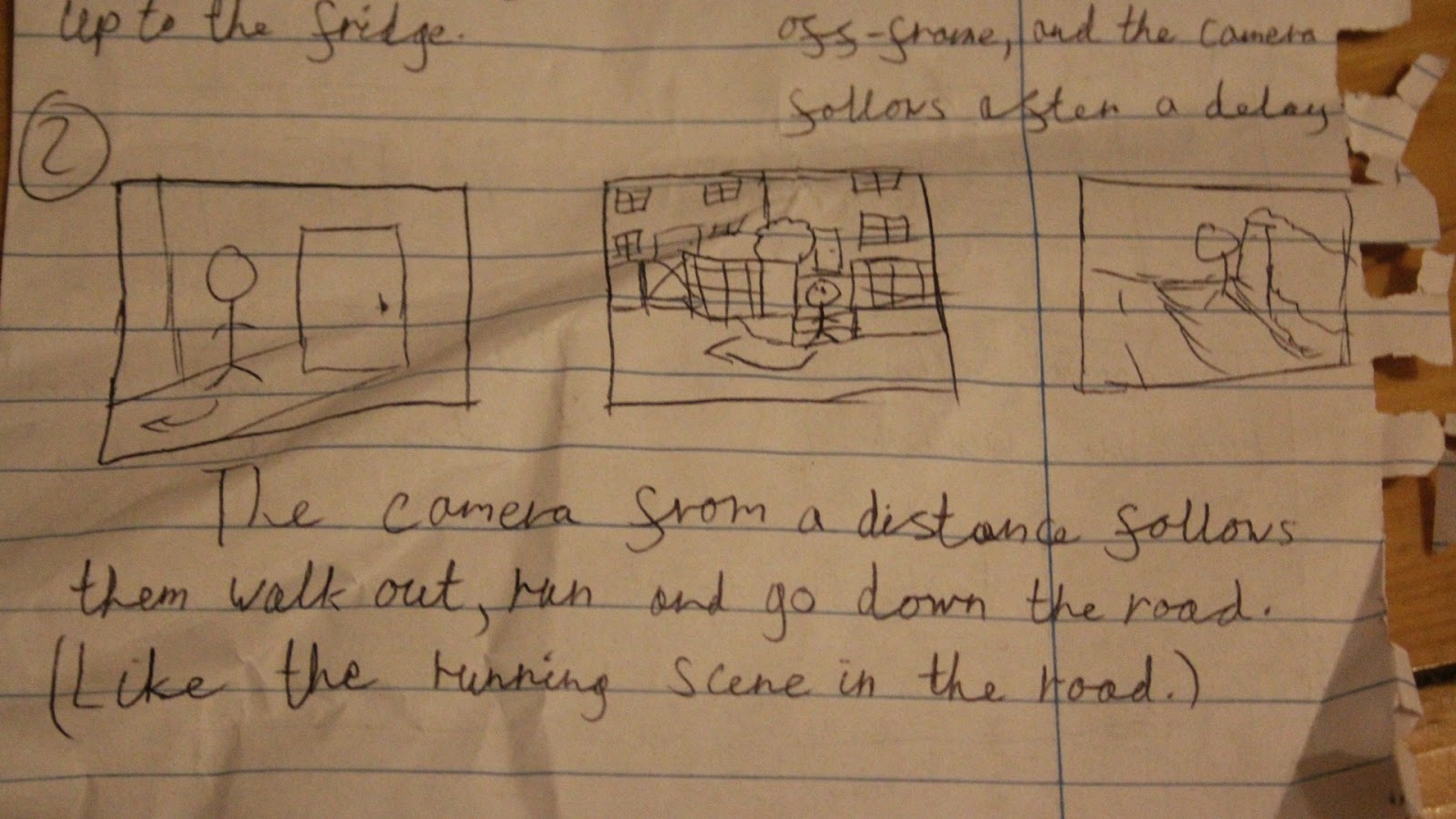
For Chapter 2, I collaborated with another student as both of us were looking at 'The Graduate' for inspiration. Our original idea actually differed from the final film by a large amount. Originally, our film focused on a man who forgets to buy a turkey for Christmas and rushes to the shops to buy one. The way this would incorporate the source material would be through the cinematography. 

The first shot we studied was the one that shows Ben (Dustin Hoffman) running towards Elaine's (Katharine Ross) wedding. His struggle is conveyed by the way that it appears as if he's running for longer than he should be by a good trick of the camera. In reality, the pavement shouldn't be that long but the way the camera is positioned and used makes it look like it's longer than it actually is. 


The second shot we looked at was the very last shot of the film which sees the bus Ben and Elaine riding on driving off, away from the camera. We felt that this shot was a very strong ending shot and we wanted to end our film with the same, accompanied by 'The Sound of Silence' by Simon & Garfunkel just as 'The Graduate' did. 


We found it appropriate due to it being December however, when we attempted to start filming, bad weather plagued the shoot. As a result, we had to completely scrap it and instead work on an idea that could be filmed no matter the weather as we knew it wasn't going to get any better for the rest of the month.

Back before we changed the idea, we managed to draw up simple storyboards in order to convey how we would shoot the film as well as highlighting the narrative. 


We found it appropriate due to it being December however, when we attempted to start filming, bad weather plagued the shoot. Our new idea was simpler as all it entailed was someone being late for their bus. However, this allowed us to incorporate the music in a more inventive fashion. In initially feels like the music is non-diegetic however when the man pulls his headphones off, it's revealed that the music is playing from his phone. The film bookends this with 'The Sound of Silence' at the end. 

Practical Screencraft: Chapter 1 Idea

For Chapter 1, I had to analysis the ending sequence to 'The Graduate' (Mike Nichols, 1967). To go about doing this, I took on a more unique take on the project. My previous attempt on a film anlysis simply involved me placing my voice over film clips in a 'directors commentary' style. Instead, I aimed to incorporate skills I have developed over the summer for my YouTube based reviews.

My Halloween Based Review

These videos let me learn how to use key framing in order to have images or other objects fly in from the side of the screen which made me think about bringing in film posters to instantly identify a specific film I talk about. I could also bring in arrows in order to point out a very specific portion of the screen. I also learnt about snappy editing that gave it a faster and more comedic tone. I continued to further my sound editing technique and I personally feel that sound editing has become one of my stronger aspects. I wished to continue this for chapter 1.

The main elements of 'The Graduate' I wish to explore are the cinematography, the acting and the use of sound. I find these parts of film the most fascinating and I wished to convey my intrigued with said techniques. As a way of showing how effective certain shots can be, I will use 'Skyfall' (Sam Mendes, 2012) as an example of a film which uses similar cinematography in order to convey specific feelings and meanings. 'The Graduate' for a sense of struggling as Ben (Dustin Hoffman) runs towards the church while 'Skyfall' uses it to create an uneasy feeling as Silva (Javier Bardem) is introduced.

Sunday, 6 December 2015

Practical Screencraft: After Effects Tests

During our lessons, we have taken a look at After Effects. While I knew about what it did, I have never actually used it before so this was a new experience for me. At first I thought it would be intimating however I soon realised that it was quite similar to things I have done before, most notably key framing. I have experimented with key framing in Sony Vegas before and have grown quite competent using however a whole program dedicated offers much more tools and variety. An example of using key frames can be seen here:


The planes that fly by are still images blurred to appear as if they are moving by quickly. Since they are still images, I simply key framed the image to travel from one side of the screen to the other. As mentioned, this was familiar territory so it was a good way of easing me into the program. 

Our second exercise proved to be more useful as these were techniques that I wanted to know but never got around to. Most notably, green screen and masking. The clip below shows an example of both:


The subject seen was filmed entirely on a green screen and imposed into a still image. Getting rid of the green screen was simple however making sue the mask was set up correctly to have him emerge from behind the wall was tricky. Sony Vegas only masks in a straight line while After Effects lets you draw out the exact shape which let me draw around the archway, therefore allowing the subject to pass the wall.

These are techniques I will use in the future as well as using After Effects. Having access to this new equipment allows for more experimentation with how films can be done.

Wednesday, 27 May 2015

Link to 'Slade' Ten Page Script.

Link to script on Google Drive:

https://drive.google.com/a/pca.ac.uk/file/d/0B-Lq22sE1yYweUdYdnBLMUthZFE/view?usp=sharing

Moving Narrative - Evaluation

The Moving Narrative module was one of my most preferred modules. With the other modules, I would have to shoot a film which would always lead to a problem that is beyond my experience and therefore proves much more difficult while Moving Narrative taps into what I very much prefer doing. We were given free rein to come up with a film idea and, since we didn’t have to shoot it, it could be anything. I had my idea for years, specifically the characters and the general direction that their story would go, prior to this course however I was only recently able to ground it into a manageable format. My original plan for my ‘Slade’ universe was as a TV show however I whittled it down and managed to fit it into a number of different films as a franchise.

For the project, we had to show our research into our desired film idea with both written work and a mood reel/poster that capture the tone or inspiration. My biggest inspiration was the ‘Lupin III’ franchise, specifically the second film ‘The Castle of Cagliostro’. My characters and scenarios were inspired by said film so a spend time looking into the history of the franchise and what it entails overall. My most interesting discovery was the live action version of ‘Lupin III’ that was released last year as it is close to what I was envisioning based on iconography and aesthetic.

The area that I was most proud of was my mood reel. I feel that it came together really well. It began a bit hard as I had to pinpoint which footage to use and whether I could actually find it or not. However, once I did, it was a fun process of putting everything together. I knew from the very beginning that I would use a song from the score of ‘The Castle of Caglisotro’ which is why the mood reel began and ended with the song so that it could start and end naturally. The clips were also timed perfectly with the music which especially stuck out to me.

I found the biggest difficulty with making a poster. My Photoshop skills are very limited and, while I did incorporate some aspects I picked up from complementary studies, there were still some things that didn’t work so well. The good things include meshing together two separate people to create Slade’s silhouette while Drake’s was the perfect look by default. I had to splice the 10th Doctor’s head from ‘Doctor Who’ onto a model’s body for Slade. As it was in silhouette, the detail didn’t matter so I could get away with not cleaning up the neckline. The background is also very generic and couldn’t find anything else more fitting. I do like the font however and I believe that my use of institutional information is strong. The actors listed wouldn’t be my final choices but act more as a guideline for what type of character they are trying to portray.

The script writing process was very erratic. When I got around to starting the piece, I got so enthralled in it that I managed to turn out a seven page draft after one writing session. I believe that my experience with these characters that I’ve had in my mind for so long as well as finding films and shows trying to hit my desired tone, such as ‘The Lone Ranger’ and ‘Guardians of the Galaxy’. However I found difficulty trying to convey what I wanted while also making it believable as the first ten pages of a feature length film. For example, I wanted to show off my characters but I feel that the pacing suffered as a result. Within the first ten pages, five of the main characters are introduced including the villain. This seems a bit rushed. Luckily, I spread it out a bit in later drafts and gave more time to chill, evident by Slade and Drake’s conversation in the hotel room and a look at Amos’ personal life.   


Overall, I enjoyed this module. It allowed me to focus solely on the idea stage of film and create our own characters and narratives without the limitation of having to make the film ourselves. I appreciated that I could finally ground my ideas that I’ve had brewing in my brain for years and work them into a thought out narrative. It also gave me an opportunity to use my favourite film in my research as it acted as my biggest inspiration. I’m proud of my mood reel and feel it’s one of my strongest pieces of editing through both visual and audio however my poster needs a lot of adjustments.